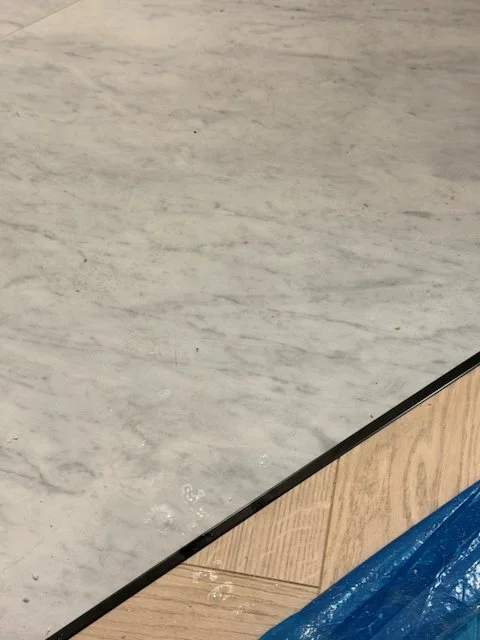
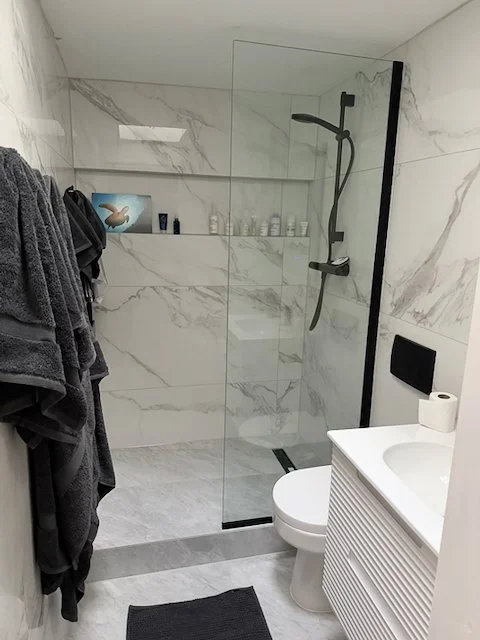
Compact wellness — water, stone, light and the feeling of exhale.
By the time the studio reached this phase, it had already travelled through collapse, pause, correction, and rebuilding. Electrics had been stripped and certified. Floors had been relaid properly. Systems, storage, and layout were finally beginning to work together as explored in Turning Chaos into Order.
The bathroom, however, carried the most layered history of all.
It was the only room that had once looked “finished.”
It was also the room that proved how incomplete “finished” can be.
This chapter is not a reveal.
It’s a correction.
Before — A False Finish
By May, the bathroom was technically “finished.”
Tiled, installed, switched on. On paper, it had crossed the line into completion. But something never settled. The proportions felt unresolved. The calm I had designed for didn’t land in the way I expected it to. The details were all there — yet the room never quite relaxed.
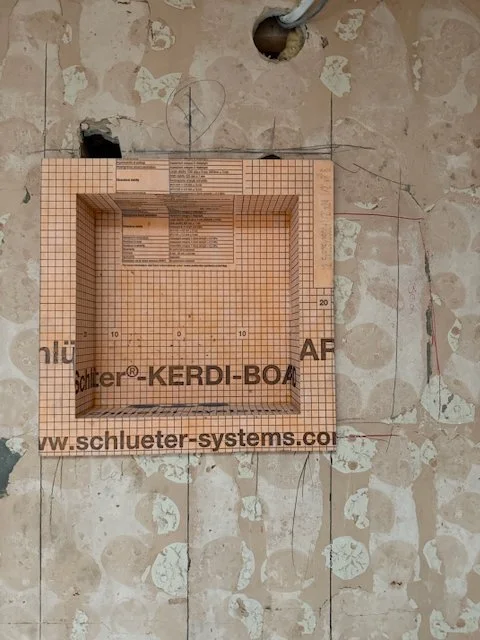
The original plan had been precise. Long, quiet tile lines to carry the eye. A recessed shelf that stretched horizontally and felt architectural. A walk-in shower intended to open the room, not compress it.
In reality, some of those intentions were translated too literally — and others not at all. The shelf existed, but as a small square box rather than a long, considered line. Technically correct. Practically awkward. Visually abrupt. The walk-in shower, instead of expanding the space, ended up doing the opposite.
Then the plan shifted physically.
A wall was moved forward by a foot. I had already bought the second fixes. What slowly became clear was that the room had shrunk — not slightly, but meaningfully — and the original spatial logic no longer applied in the same way. Valuable space was lost before I had the chance to rethink the design around it.
At the time, the room looked finished.
But it wasn’t finished in the way that matters.
It took what came next for that to be fully revealed.
During — Stripped Back, Re-Aligned
The second strip-out was not planned. It wasn’t aesthetic. It was necessary.
When the room was opened back up, what had been invisible became unavoidable. Electrical problems surfaced behind the walls. Tiles failed. As damaged second fixes were removed, it became clear how much cracking, burning, and stress had been hidden beneath surfaces that once read as “complete.”
This wasn’t a cosmetic redo.
It was a structural correction.
Everything came back to the bones again — substrate, routing, levels, waterproofing, tolerances. The work this time wasn’t about getting the room finished. It was about getting the room truthful.
And unexpectedly, inside that disruption, there was a rare opportunity.
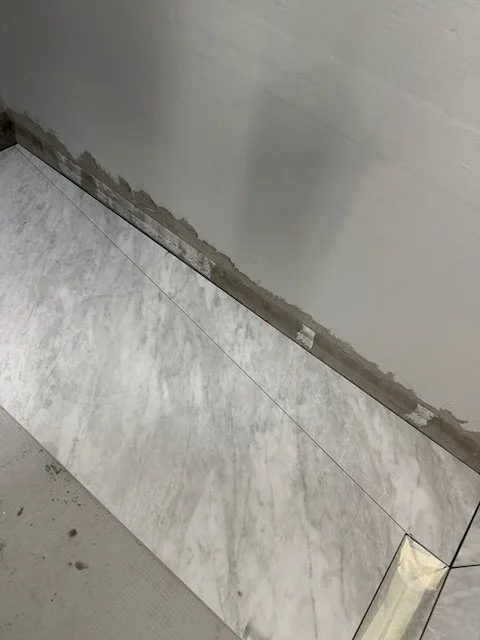
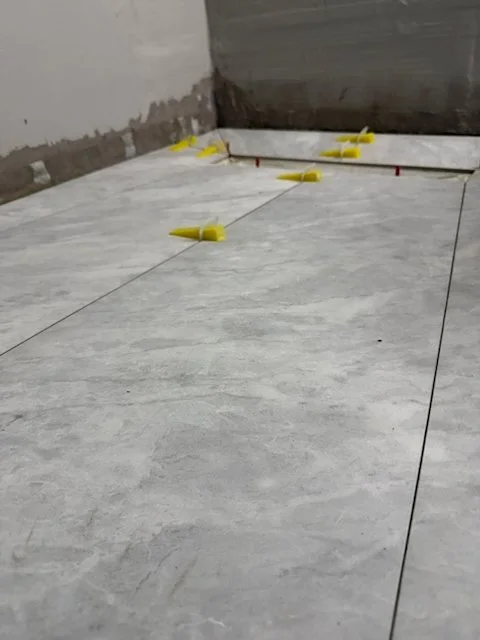
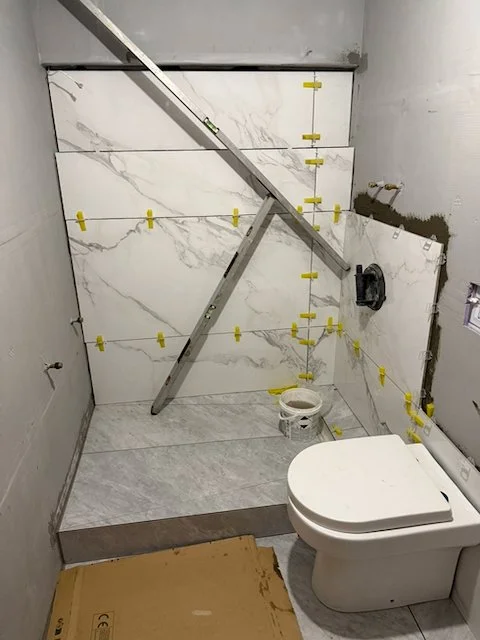
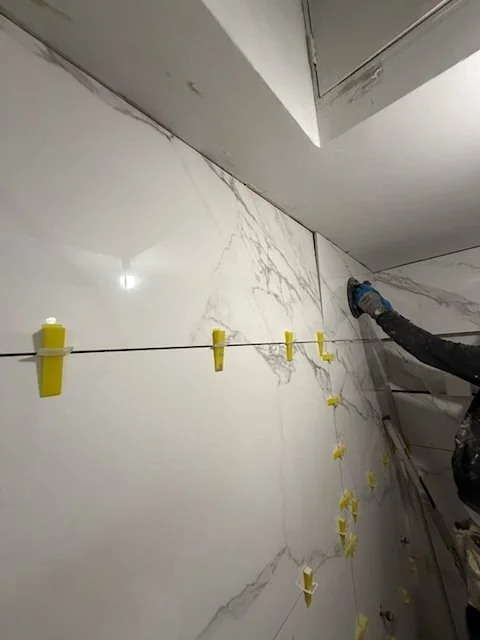
Because the second fixes had to be removed anyway, and because the space was now definitively smaller, I was finally able to revisit the original vision — not as a repeat, but as an adaptation. The long shelf could return in spirit, even within tighter limits. The tile lines could once again be used to lead the eye instead of interrupt it. The calm could be rebuilt around what the room actually was, not what it used to be on drawings.
This phase was slow. Dusty. Full of drying times and invisible layers. Underfloor heating was laid correctly. Waterproofing was applied with care. Tiles were placed and checked, then checked again. Levels mattered. Alignment mattered. Nothing was rushed forward to resemble completion.
For the first time, the room was being built at the same tempo as the intention that shaped it.
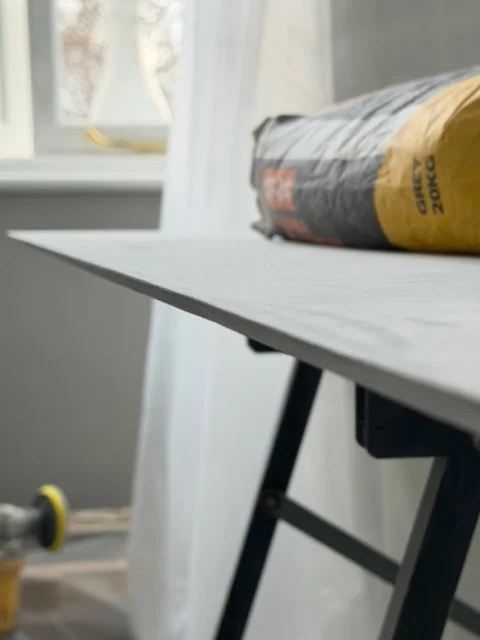
After — The Discipline of Quiet
The finished bathroom is intentionally quiet.
Not because nothing happened here —
but because everything finally did.
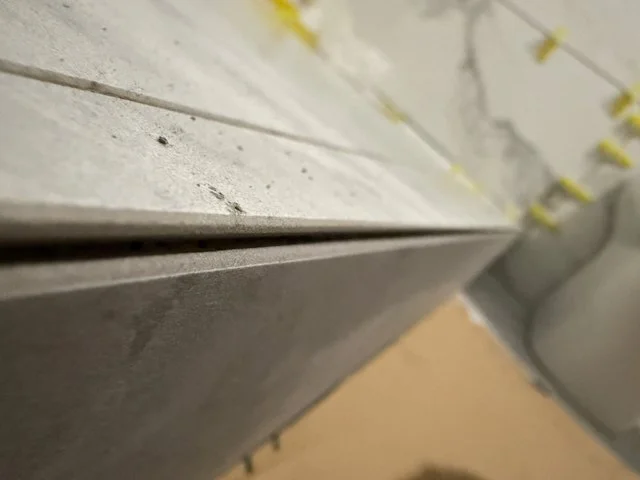
There is no visual noise now. No excess gesture. No moment that raises its voice. What remains is proportion, alignment, and light behaving the way it was always meant to. The shelf runs in a single, calm line. The tile joints meet with patience rather than urgency. Edges finish cleanly because someone took the time to make them finish cleanly.
This kind of simplicity is not effortless.
It is the most demanding version of execution there is.
When a room is loud, mistakes hide easily.
When a room is quiet, everything is exposed.
Every millimetre matters. Every junction shows. Every decision either supports calm or fractures it. This bathroom now carries the weight of that discipline — the kind that only comes from doing things twice, correcting what was rushed, and insisting that the smallest details deserve the same care as the visible ones.
Perseverance doesn’t announce itself here.
It lives in what no longer interrupts you.
The underfloor heating settles into the room instead of demanding attention. The materials hold temperature and light without performance. Stone, metal, and water don’t compete — they cooperate. The room no longer tries to prove itself. It simply works.
And that, after everything, feels like the real luxury.
In many ways, this room returns to the original intention set at the very beginning of the studio — the pursuit of a space that felt calm, compact, and connected to daily ritual, first articulated in Calm, Compact, Connected.
It’s still a compact room. It always will be.
But it no longer feels compromised.
The original intention — a place to exhale — has survived correction, reduction, and reconfiguration. Not because conditions were ideal, but because the vision was protected long enough to be translated honestly into the reality that remained.
With the bathroom finally resolved, the studio itself begins to breathe differently. The systems now run quietly in the background, no longer asking for attention. What remains is the final physical chapter still in motion — the kitchen — where the last major layer of this pied-à-terre will come into alignment in The Kitchen Build.
For now, this room holds the quiet proof that perseverance, when paired with execution, doesn’t need to announce itself.
It only needs to endure.